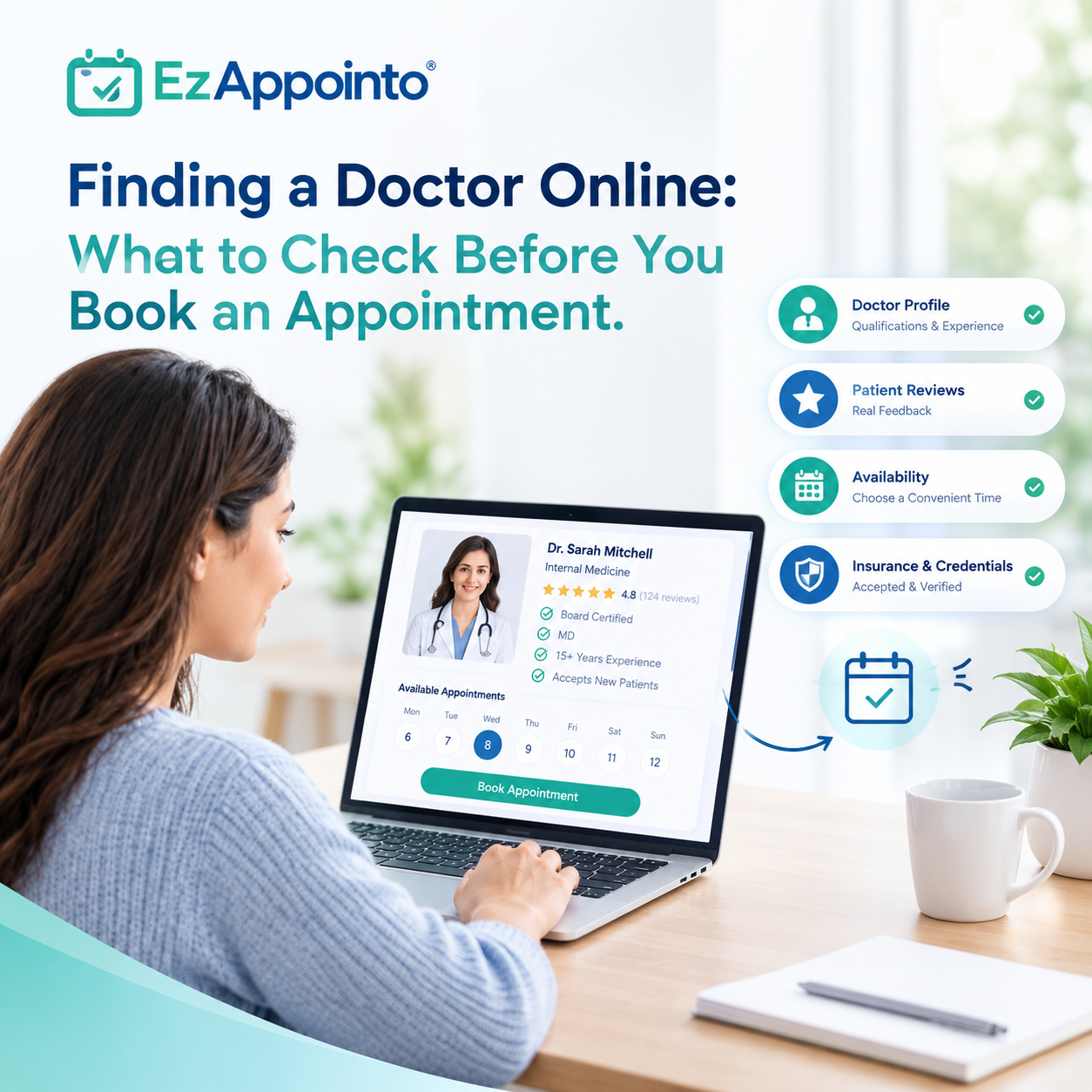
Finding a doctor online: what to check before you book an appointment
A woman relocating for a new job once spent an entire Sunday night scrolling through search results trying to find a new primary care doctor in a city, she'd never lived in. Every listing looked the same: a stock photo, a five-star rating with no context, and a booking button that led to a phone number nobody answered until Monday. She had no way to tell whether the glowing reviews were real, whether the doctor's license was actually in good standing, or whether the practice even took up new patients. She picked one at random and got lucky. Not everyone does.
Finding a doctor used to mean asking a neighbor or calling your insurance company for a list of names with no context attached. Now it mostly happens online, which solves the convenience problem but introduces a new one: how do you actually verify that the person you're about to trust with your health is who and what they claim to be, before you've committed a copay and an afternoon to finding out the hard way?
Why "Just Google It" Isn't Actually a Strategy
Searching for a doctor online returns a flood of results, directory listings, practice websites, review aggregators, none of which are built specifically to help you verify credentials or book with confidence. A typical search mixes paid ads, outdated directory entries, and reviews that may or may not reflect a doctor's current practice, current location, or even whether they're still accepting new patients.
This matters more than it might seem. Choosing a healthcare provider isn't like choosing a restaurant, where a bad choice costs you one disappointing meal. The Agency for Healthcare Research and Quality emphasizes that good communication with a provider you trust is directly tied to better health outcomes, including more accurate diagnoses and better recovery from treatment. Finding the right fit isn't a nice-to-have; it's a meaningful factor in the quality of care you actually receive.
What Actually Matters When Verifying a Provider
A handful of concrete checks separate a genuinely informed choice from a coin flip, and knowing what to look for makes the search considerably less stressful.
License status and disciplinary history. Every physician practicing in the United States is licensed by a state medical board, and that licensure status, along with any disciplinary actions, is public record. The Federation of State Medical Boards maintains a free, national database covering more than 900,000 licensed physicians, letting anyone confirm a doctor's license is active and see whether they've faced formal discipline. This single step catches the rare but real cases where a practitioner's credentials don't hold up to scrutiny, and it takes less time than reading a single page of reviews.
Board certification in the relevant specialty. A license confirms that someone can legally practice medicine. Board certification confirms they've completed additional training and testing in a specific specialty, cardiology, dermatology, family medicine, and so on. For anything beyond routine primary care, checking that a provider is board-certified in the specialty you need is worth the extra minute.
Whether reviews reflect real, verified patients. Review volume alone tells you very little. A handful of detailed reviews from patients who clearly describe their actual visit and experience are more useful than a large number of vague, generic five-star ratings that could have come from anywhere.
Practical fit: location, availability, and insurance. None of the above matters if a provider isn't accepting new patients, doesn't take your insurance, or is a ninety-minute drive away. This is where a lot of directory searches quietly fail patients, surfacing highly rated providers who turn out to be functionally inaccessible once you try to actually book.
Where a Purpose-Built Platform Changes the Search
General search engines and generic directories weren't built with medical verification in mind, they were built to return relevant links. A platform designed specifically around healthcare scheduling can bake these verification steps directly into the search experience instead of leaving patients to piece it together across five different tabs.
Ezappointo is built around exactly this gap, connecting patients with verified professionals rather than an unfiltered list of listings scraped from the open web. The platform's find-a-professional search lets patients search directly for verified doctors, clinics, and wellness professionals and see real availability rather than a static profile that may or may not reflect who's actually taking new patients this week.
Why HIPAA-Compliant Booking Actually Matters to You as a Patient
It's easy to think of HIPAA compliance as a back-office concern that only matters to the practice, not the patient searching for care. That's a mistake. Any platform that stores your name, your reason for visiting, your contact information, and your appointment history is handling protected health information, and federal guidance is explicit that technology handling this kind of data must comply with HIPAA's Privacy, Security, and Breach Notification Rules, whether it's a scheduling tool, a video visit platform, or both combined.
This matters directly to you because a booking platform that isn't built around these protections is handling your sensitive information with less rigor than your provider's own medical records system. When a platform advertises HIPAA-conscious workflows and secure, built-in video visits rather than routing you through a separate, unverified third-party video tool, that's not a marketing detail, it's a real difference in how carefully your information is being handled from the moment you search for a provider through the moment your appointment ends.
What a Good Booking Experience Should Actually Look Like
Once you've found a provider worth trusting, the booking experience itself shouldn't reintroduce the friction you just avoided. A few things separate a genuinely patient-friendly platform from one that just moved the same old problems online.
Real-time availability should reflect what's actually open, not a static calendar a staff member updates once a week. Digital intake forms should let you provide your information ahead of time instead of filling out the same clipboard forms you've filled out at every visit for the past decade. If a video consultation is part of the visit, it should be built directly into the platform rather than requiring you to download a separate app or click through an email link that may or may not work when the appointment actually starts. And reminders should arrive through the channel you actually check, text or email, rather than a phone call you're likely to miss.
None of this is complicated technology. It's simply a platform built around what actually reduces friction for a patient trying to get care, rather than one built primarily around what's convenient for the practice's back office.
How Patient Search Behavior Is Already Shifting
The way people search for care has changed meaningfully in the past couple of years, and it's worth understanding where that's headed. Recent research on patient decision-making found that patients switching providers increasingly cite AI-powered search tools as their top influence, in some cases trusting AI-generated search summaries more than traditional organic results or paid advertising when evaluating a new provider.
This shift reinforces exactly the point above: patients are increasingly relying on tools that synthesize and verify information rather than manually cross-referencing five different sources themselves. A platform built specifically to surface verified providers with real, current information is positioned to serve that expectation directly, rather than a generic search result a patient then has to independently fact-check.
Red Flags Worth Taking Seriously
A few warning signs are worth trusting when you spot them, even if everything else about a listing looks polished. A provider whose license status can't be confirmed, or whose license shows an active disciplinary action, is a legitimate reason to look elsewhere regardless of how good their reviews look, since disciplinary records exist precisely to flag providers whose conduct fell short of the standard patients deserve. A profile with no verifiable board certification for the specialty being advertised is worth a direct question rather than an assumption. And a booking process that never mentions how your information is protected, no reference to HIPAA-conscious handling, no clarity about who has access to your intake forms, is worth pausing on, since that silence often means the platform simply hasn't built those protections in.
None of these checks take more than a few minutes individually, and together they turn what used to be a guessing game into a process you can actually trust. The extra few minutes spent verifying a provider before booking is a small investment compared to the time and stress of discovering a mismatch after your first visit.
A Practical Checklist Before You Book
Before committing to a new provider, a short mental checklist takes the guesswork out of the decision. Confirm the provider's license is active and check for any disciplinary history through a resource like DocInfo. Verify board certification if you're seeking specialty care rather than general primary care. Read a handful of detailed reviews rather than just checking the star average, and be skeptical of listings with only vague, generic feedback. Confirm the practical details, location, insurance, and actual appointment availability, before getting attached to a provider who turns out to be inaccessible. And if telehealth is part of the plan, make sure the booking platform itself handles your information with real HIPAA-conscious safeguards rather than routing you through a patchwork of disconnected tools.
Getting Started
If you're searching for a provider you can actually trust, take a look at how Ezappointo's find-a-professional search connects you with verified doctors, clinics, and wellness professionals, complete with real-time availability and secure booking built around your actual information, not a generic directory listing. You can also explore Ezappointo's full platform to see how scheduling, secure video visits, and digital intake all work together to make finding and booking care simpler from the very first search.